Would Make Christopher Reeve Walk Again
Christopher Reeve's recovery
Christopher Reeve demonstrated to the world that he had recovered some motion and awareness. While he could not walk, did not regain bowel, float, or sexual function, nor could he breathe without a ventilator, his express recovery was significant.
The scientific literature on spinal cord injury predicts that most recovery will occur in the starting time six months after injury and that it is generally complete inside two years. Christopher's recovery, coming five to seven years afterward his injury, defies these medical expectations and had a dramatic effect on his daily life.
Why did Christopher Reeve become better so long after his injury? He believed his improved function was the result of vigorous physical action.
Christopher began exercising the year he was injured. 5 years afterwards, when he get-go noticed that he could voluntarily move an alphabetize finger, Christopher began an intense exercise program under the supervision of Dr. John McDonald at Washington University in St. Louis.
Christopher included several activities in his plan. He used daily electrical stimulation to build mass in his arms, quadriceps, hamstrings and other muscle groups. He rode a Functional Electrical Stimulation (FES) bicycle, did breathing training and also participated in aquatherapy.
In 1998 and 1999, Christopher underwent treadmill training to encourage functional stepping. His experience with treadmill training was the foundation of the Reeve Foundation's NeuroRecovery Network.
Christopher and Dr. McDonald believed that these activities may have awakened fallow nerve pathways.
Dr. McDonald and other researchers and clinicians caution not to over-translate Christopher's results. Clearly, not all people with paralysis would do good from a similar programme and you should e'er consult your doctor earlier starting or irresolute a fitness government.
A fitness programme built for Superman
It is true for whatever of the states: exercise is related to better wellness. There are few, if whatever, negative side effects of exercise. Fifty-fifty people who don't experience recovery in the mode that Christopher Reeve did are probable to enhance their well-being.
Christopher's participation in practice was motivated by the well-known benefits on cardiovascular function, muscle tone, bone density, etc. Indeed, he had fewer medical complications such as bladder and lung infections.
Before 1999, Christopher frequently required hospitalization – he had a full of nine life-threatening complications and required almost 600 days of antibody handling.
Later on 1999, he was rarely hospitalized, had merely one serious medical complication, and needed simply lx days of antibiotic treatment.
These improvements in his health boosted Christopher's emotional well-being and enabled him to commit to a variety of work projects knowing he could give them his uninterrupted attention.
Now, scientists are working to develop cutting-border therapies to afford the same benefits to other people living with paralysis.
Christopher Reeve'southward experience is an example of what tin can happen when one refuses to accept the "get used to it" dogma. Although information technology is not clear what caused his recovery, his improvements in function provide a source of hope and inspiration for others.
He was a strong advocate for making new technology and therapies more widely available.
I have the staff and the equipment. Merely what I really hope comes out of my experience is a paradigm shift in the mode insurance companies do business. If insurance companies would pay for proactive therapy and equipment they would save coin keeping people similar me out of the hospital. People with lower level injuries would get up and leave of their chairs. It's a win-win proposition.
– Christopher Reeve
Below is a rundown on the various activities that were in Reeve'south exercise programme:
Note: before considering participation in avant-garde rehabilitation therapies, such every bit FES or treadmill training, it is of import to consult your md to ensure that the therapies are appropriate and safe.
Functional Electrical Stimulation (FES)
Christopher Reeve did one hour of exercise at least three times a week on an FES bike.
This technology allows persons with lilliputian or no voluntary leg movement to pedal a stationary leg-cycle called an ergometer. Computer generated, depression-level electrical pulses are transmitted through surface electrodes to the leg muscles. This causes coordinated contractions and the pedaling movement.
FES bikes are not new and have been on the market for over 20 years. Moreover, FES systems have been deployed in research centers throughout the world for the last several years.
Here in the U.Southward., there are a couple of companies currently producing the bikes. Therapeutic Alliances, Inc., one of the oldest manufacturers, makes the Ergys 2. Restorative Therapies, Inc. offers the RT300-S which is operated direct from the wheelchair eliminating the need for transfer.
FES bikes are also not cheap – they are in the range of $15,000. Some insurance companies have reimbursed for units. In that location are bikes bachelor in some customs settings, at health clubs and rehab clinics.
The kickoff stride is to choose a cycle that is mechanically audio. All the electronics are upgradeable from the manufacturers. Each wheel has a programme cartridge prepare for the specific needs of each passenger, including run times, resistance, etc. A prescription is needed to get the cartridge. For safety reasons, information technology'due south not recommended that FES bicycle riders use another's cartridge.
Arable medical literature documents the effectiveness of FES to increase musculus mass and improve cardiopulmonary function. There are studies that also link FES to a reduced frequency of pressure sores, improved bowel and bladder function and decreased incidence of urinary tract infections.
Co-ordinate to Dr. McDonald, the FES bike tin be more useful than for just building musculus mass. "We propose to use them for a totally dissimilar reason – to promote regeneration and recovery of part. Nosotros at present take data demonstrating that [FES] activity tin can enhance regeneration in animals and is associated with recovery of office in humans."
Treadmill or Locomotor Preparation
Locomotor Training is a rehabilitation approach that has been emerging over the terminal decade. It involves a kind of action-triggered learning whereby practicing a series of specific movements (in this case, stepping) triggers the sensory data that somehow reminds the spinal cord how to initiate stepping.
Locomotor Training uses repetitive motion to teach the legs how to walk again. A paralyzed person is suspended in a harness above a treadmill, reducing the weight the legs will take to bear. As the treadmill begins to move, therapists manually motion the person'due south legs in a walking pattern.
The ultimate goal of Locomotor Grooming is to retrain the spinal cord to 'recall' the blueprint of walking.
The theory behind locomotor training is that the injured nervous organization may be "plastic," and capable of recovery when patterned neural activeness, like stepping, is optimized.
Enquiry from the Academy of California at Los Angeles and in Germany, Switzerland and Canada, notes that the spinal cord itself appears to act like a small brain and is thus capable of controlling stepping. The spinal string makes many routine decisions virtually the correct way to walk. When an individual living with paralysis is retrained to walk, both the brain and spinal string figure out new ways to practice it.
Many people with paralysis, regardless of time elapsed since onset, have improved their walking after receiving Locomotor Training. The level of recovery is different for each person, although almost all those with incomplete injuries showed gains.
It is of import to understand that Locomotor Training is an evolving therapy and may not help everyone to walk improve. People have seen other benefits beyond walking like improved wellness and well-being.
As treadmill units filter out into the community, it is important for people to recognize that a Locomotor Training programme must include highly trained therapists to work with patients. Maximizing a patient's ability to stride after injury depends to a very large extent on the skill and precision with which the therapists deliver locomotor grooming.
Locomotor Training is the principle therapy offered by the Reeve Foundation's NeuroRecovery Network (NRN), which is a network of cutting-edge clinical rehabilitation centers and Customs Fitness and Wellness Facilities that make upward 2 branches of intendance for people living with spinal cord injury and other concrete disabilities.
Aquatherapy
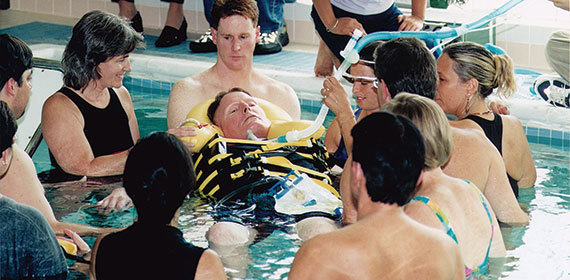
Christopher Reeve demonstrated the ability to move his legs and arms in a pool. The effects of gravity are greatly reduced in water then that small body movements tin exist more hands detected and therapists can determine a person's maximum ability to move without the total resistance of gravity.
Also, when people are beginning to recover motility, h2o makes do easier. When time permitted, Christopher did aquatherapy once a week for approximately two hours.
Bone density treatment
Since people with paralysis don't typically put weight or pressure on their bones, they tend to lose os density and often develop osteoporosis.
With drugs and do on the FES bicycle, Reeve's osteoporosis was reversed to normal bone density.
Resources
If you are looking for more information on exercise or have a specific question, our information specialists are bachelor concern weekdays, Monday through Friday, cost-gratis at 800-539-7309 from 9am to 8pm ET.
Additionally, the Reeve Foundation maintains a fact sheet on fitness and exercise with additional resource from trusted Reeve Foundation sources. Check out our repository of fact sheets on hundreds of topics ranging from state resource to secondary complications of paralysis.
We encourage you to reach out to other organizations specializing in activity-based therapies, including:
- Clinical Trials: Ambulation Programs includes a listing of ambulation programs currently seeking volunteers.
- Clinical Trials: Locomotor (treadmill) Training includes a listing of trials involving Locomotor (treadmill) Training.
- Model Systems Knowledge Translation Centre offers fact sheets produced through a collaboration between the MSKTC and the SCI Model Systems. These materials undergo expert and consumer reviews to ensure they are up-to-date, evidence-based, and consumer-friendly.
- Lokomat Plan at Rehabilitation Establish of Chicago provides robot-assisted walking therapy using the Lokomat® to help people meliorate their ability to walk after inability caused by brain and spinal cord injuries, stroke or neurological and orthopedic conditions.
Source: https://www.christopherreeve.org/living-with-paralysis/rehabilitation/christopher-reeve-exercise-program
0 Response to "Would Make Christopher Reeve Walk Again"
Post a Comment