Who Is the Top 4 Percent in Language Arts at Colorado Age 15

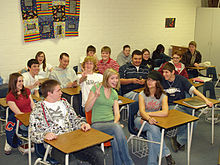
Secondary education in the United States is the last seven years of statutory formal education form 6 (age 11–12) through grade 12 (age 17–18). It occurs in ii phases. The first is the ISCED lower secondary phase, a heart school or junior high schoolhouse for students form vi (historic period xi–12) through grade 8 (age 13–14). The 2nd is the ISCED upper secondary phase, a high schoolhouse or senior high schoolhouse for students grade nine (age xiv–15) through grade 12 (age 17–18).[i] There is some debate over the optimum age of transfer, and variation in some states.[2]
History [edit]
High school enrollment increased when schools at this level became free, laws required children to attend until a certain age, and information technology was believed that every American student had the opportunity to participate regardless of their ability.[3]
In 1892, in response to many competing academic philosophies being promoted at the time, a working group of educators, known as the "Committee of Ten" was established by the National Pedagogy Association. It recommended twelve years of teaching, consisting of eight years of simple didactics followed past four years of loftier schoolhouse. Rejecting suggestions that high schools should separate students into college-spring and working-trades groups from the start, and in some cases also by race or ethnic background, they unanimously recommended that "every subject which is taught at all in a secondary school should be taught in the same manner and to the aforementioned extent to every student so long as he pursues it, no matter what the probable destination of the educatee may be, or at what point his education is to cease."[iv]
At the turn of the 20th century, it was common for high schools to accept archway examinations which restricted entrance to fewer than 5 percent of the population in grooming for college. Nigh were expected to be set up for a job or a family subsequently junior high schoolhouse.[ commendation needed ]
The first public secondary schools started around the 1830s and 40s inside the wealthier areas of similar income levels and profoundly expanded subsequently the American Ceremonious War into the 1890s.[5]
Betwixt 1910 and 1940 the "loftier school movement" resulted in rapidly increasing founding of public high schools in many cities and towns and later with further expansions in each locality with the establishment of neighborhood, district, or community high schools in the larger cities which may have had i or 2 schools since the 19th century. High school enrollment and graduation numbers and rates increased markedly, mainly due to the building of new schools, and a applied curriculum based on gaining skills "for life" rather than "for college". There was a shift towards local decision making by school districts, and a policy of easy and open enrollment. The shift from theoretical to a more practical approach in curriculum also resulted in an increase of skilled blue-collar workers. The open enrollment nature and relatively relaxed standards, such as ease of repeating a class, also contributed to the blast in secondary schooling. In that location was an increase in educational attainment, primarily from the grass-roots movement of edifice and staffing public high schools.[ citation needed ] By mid-century, comprehensive loftier schools became mutual, which were designed to requite a free education to any student who chose to stay in schoolhouse for 12 years to get a diploma with a minimal grade point average.
In 1954 the Supreme Court case Brown v. Board of Education made desegregation of elementary and loftier schools mandatory, although private Christian schools expanded rapidly post-obit this ruling to accommodate white families attempting to avoid desegregation. [6] [vii] [8]
By 1955, the enrollment rates of secondary schools in the United states were around 80%, higher than enrollment rates in nigh or all European countries.[ix] The goal became to minimize the number who exited at the mandatory omnipresence historic period, which varies by state between xiv and 18 years of age, and become considered to be dropouts, at risk of economic failure.[ commendation needed ]
In 1965 the far-reaching Unproblematic and Secondary Education Act ('ESEA'), passed as a part of President Lyndon B. Johnson's "War on Poverty", provided funds for primary and secondary education ('Title I funding') while explicitly forbidding the establishment of a national curriculum.[x] It emphasized equal admission to educational activity and established high standards and accountability.[11] The neb also aimed to shorten the achievement gaps between students by providing every child with fair and equal opportunities to achieve an infrequent educational activity.
After 1980, the growth in educational attainment decreased, which caused the growth of the educated workforce to slow downwardly.[12]
Under the educational activity reform motion started in the early 1990s by many state legislatures and the federal government, about ii-thirds of the nation'due south public high school students are required to pass a graduation test, unremarkably at the 10th and higher grade levels, though no new states had adopted a new requirement in 2006.[xiii] This requirement has been an object of controversy when states take started to withhold diplomas, and the right to attend outset exercises, if a student does not meet the standards set by the land.
Pressure level to allow people and organizations to create new Charter schools developed during the 1980s and were embraced by the American Federation of Teachers in 1988. These would be legally and financially autonomous public school free from many state laws and district regulations, and accountable more for student outcomes rather than for processes or inputs. Minnesota was the get-go state to laissez passer a lease school constabulary in 1991. By 2009 charter schools were operating in 41 states (and the Commune of Columbia) and 59% of these had waiting lists.[14]
The No Child Left Backside Human action of 2001 required all public schools receiving federal funding to administrate a statewide standardized test annually to all students. Schools that receive Title I funding must make Adequate Yearly Progress (AYP) in test scores (e.g. each year, fifth graders must do meliorate on standardized tests than the previous twelvemonth's fifth graders) and Schools that miss AYP for a second sequent yr are publicly labeled equally in need of improvement, and students have the option to transfer to a meliorate school within the school district, if any exists.[15] Standards-based pedagogy has been embraced in most states which changed the measurement of success to bookish achievement, rather than the completion of 12 years of education. By 2006, ii-thirds of students lived in states with effective standards requiring passing tests to ensure that all graduates had achieved these standards.
Curriculum [edit]
Say-so to regulate education resides constitutionally with the individual states, with direct authority of the U.S. Congress and the federal U.S. Section of Education beingness express to regulation and enforcement of federal constitutional rights. Great indirect authority is, notwithstanding, exercised through federal funding of national programs and block grants although there is no obligation upon whatever state to accept these funds. The U.S. government may also propose, just cannot enforce national goals, objectives and standards, which generally lie beyond its jurisdiction.
Many loftier schools in the United States offer a option of vocational or college prep curriculum. Schools that offer vocational programs include a very loftier level of technical specialization, e.one thousand., auto mechanics or carpentry, with a half-24-hour interval instruction/canonical piece of work program in senior year as the purpose of the program is to set up students for gainful employment without a higher caste. The level of specialization allowed varies depending on both the land and district the schoolhouse is located in.
Core [edit]
Many states require courses in the "core" areas of English, scientific discipline, social studies, and math every year although others allow more choice after 10th form. The majority of high schools require four English credits to graduate.[sixteen]
Mostly, three science courses are required. Biology, Chemistry, and Physics are usually offered.
High schoolhouse math courses typically include Pre-algebra, Algebra I, Geometry, Algebra II west/ trigonometry classes. Advanced study options can include Precalculus, Calculus, and Statistics generally with an opportunity to earn Avant-garde Placement (AP) or International Baccalaureate (IB) accreditation. Commonly, but three math credits are required for graduation (although four is recommended).
English language/Language classes are usually required for 4 years of high school although many schools count journalism, public speaking/debate, foreign language, literature, drama, and writing (both technical and creative) classes as English/Linguistic communication classes.
Social studies classes include History, Political Scientific discipline, Economics and Geography. Political scientific discipline and Economic science classes are sometimes combined as two semesters of a yr-long course. Additional study options can include classes in Sociology, and Psychology.
Many states require a health or health course in society to graduate. The class typically covers basic anatomy, nutrition, first assist, sexual education, and how to brand responsible decisions regarding illegal drugs, tobacco, and booze. In some places, contraception is non allowed to be taught for religious reasons. In some places, the wellness and physical education course are combined into one class or are offered in alternate semesters. In some private schools, such as Catholic schools, theology is required earlier a educatee graduates. Ii years of physical education (ordinarily referred to equally "gym," "PE" or "phys ed" by students) is unremarkably required, although some states and school districts require that all students take Concrete Education every semester.[xvi]
Electives [edit]
Public loftier schools offering a wide multifariousness of elective courses, although the availability of such courses depends upon each item school's financial situation. Some schools and states require students to earn a few credits of classes considered electives, most commonly strange language and concrete pedagogy.
Common types of electives include:
- Visual arts (drawing, sculpture, painting, photography, film studies, and art history)
- Performing arts (choir, drama, band, orchestra, dance, guitar)
- Vocational education (woodworking, metalworking, reckoner-aided drafting, automobile repair, agriculture, cosmetology, FFA)
- Figurer science/information technology (word processing, estimator programming, robotics, graphic design, calculator club, web design and spider web programming, video game pattern, music production)
- Journalism/publishing (school newspaper, yearbook, television production)
- Foreign languages (French, German, Italian, and Spanish are mutual; Chinese, Japanese, Russian, Greek, Latin, Korean, Dutch, and Portuguese are less common, though the former 2 are gaining popularity.)
- Concern pedagogy (Accounting, Data Processing, Entrepreneurship, Finance, Concern, Information and Communication Technology, Management, Marketing, and Secretarial)
- Family unit and consumer science/home economic science (nutrition, nursing, culinary, child development, and additional physical education and weight grooming classes)
- Junior Reserve Officers' Training Corps (In some schools, JROTC may supercede a credit of health or P.Due east.) and gun clubs and shooting teams
- Some American loftier schools offer drivers' educational activity. At some schools, a student can take it during school as a regular course for a credit. At some schools, drivers education courses are only available afterward school.
The Association for Career and Technical Instruction is the largest U.S. association dedicated to promoting this type of education.
Levels of instruction [edit]
Intermediate school [edit]
Intermediate schools are schools that serves grades 3 or iv through 5 or 6.
Successful completion of intermediate school leads to entry into middle schoolhouse or junior high school.
![[icon]](https://upload.wikimedia.org/wikipedia/commons/thumb/1/1c/Wiki_letter_w_cropped.svg/20px-Wiki_letter_w_cropped.svg.png) | This section needs expansion. You lot can aid by calculation to it. (Nov 2021) |
Middle school / Inferior loftier school [edit]
Middle schools, or junior high schools, are schools that serves grades 5, 6, or vii through 8 or 9 which straddle principal and secondary instruction. Upon arrival in middle school or junior high schoolhouse, students begin to enroll in class schedules where they take classes from several teachers in a given day. The classes are usually a set of four or five (if foreign language is included in the curriculum) core bookish classes (English language or "language arts," science, mathematics, history or "social studies," and in some schools, foreign language) with ii to four other classes, either electives, supplementary, or remedial academic classes.[ commendation needed ]
Some students besides showtime taking a foreign language or avant-garde math and science classes in middle school. Typically schools volition offering Spanish and French; and, often German; and, sometimes Latin; Chinese, Japanese, and/or Greek. In addition to Pre-Algebra and other high schoolhouse mathematics prep courses, Algebra I and Geometry are both usually taught. Schools also offer Earth Science, Life Science, or Physical Scientific discipline classes. Physical educational activity classes (also called "PE", "phys ed", Kinesiology, or "gym") are usually mandatory for various periods. For social studies, some schools offer U.Southward. History, Geography, and World History classes.[ citation needed ]
Most also have "honors" classes for motivated and gifted students, where the quality of didactics is college and much more is expected from the enrolled pupil.
Successful completion of middle school or junior high school leads to entry into loftier schoolhouse or senior high school.[ citation needed ]

Breakdown of different models of primary, secondary, and mail-secondary education
Loftier school / Senior high school [edit]
High schools, or senior high schools, are schools that span grades 9 or 10 through 12. Most American high schools are comprehensive high schools and accept all students from their local area, regardless of power or vocational/college rail. Students take significant command of their education, and may choose even their cadre classes, although the command given to students varies from land to state and school to school. The schools are managed by local schoolhouse districts rather than by the cardinal regime.
Some states and cities offer special high schools with examinations to acknowledge only the highest performing students, such as Boston Latin School or Alexandria, Virginia's Thomas Jefferson Loftier School. Other high schools cater to the arts. Some schools accept been gear up for students who do non succeed with normal academic standards; while others, like Harvey Milk High School, take even been created for special social groups such every bit LGBT students.[17] [eighteen] [xix]
Nigh states operate special residential schools for the blind and deafened, although a substantial number of such students are mainstreamed into standard schools. Several operate residential high schools for highly gifted students in specialized areas such equally science, mathematics, or the arts. A smaller number of high schools are operated by the Department of Defense on military bases for children of military personnel.
Most high schools have classes known as "honors" classes for motivated and gifted students, where the quality of educational activity is higher and much more is expected from the enrolled student. Some high schools offer Regular Honors (H) (sometimes called Advanced), Advanced Placement (AP) or International Baccalaureate (IB) courses, which are special forms of honors classes. International schools offering programs of report in line with foreign systems of Teaching, such equally those of Britain and France, are also bachelor. Some schools also offer dual-enrollment programs, in which select classes at a university may exist taken for both university and loftier schoolhouse credit.
Graduation from high schoolhouse or senior loftier school leads to the awarding of the high school diploma. Later this secondary education is considered complete and students may pursue tertiary level study.
Types of schools [edit]

Secondary education tin can exist provided within a number of different schools and settings.
Public schools [edit]
The United States public instruction system is structured into iii levels: elementary (too known equally primary) education, middle and loftier school (which is secondary together) education, and college or university level (as well known as post-secondary) education. Schooling starts at age 5-6 and ends anywhere from 16-18 depending on the school organization, state policy, and the students progress. Pre-School or Pre-Kindergarten accept as immature as age three and is not required. From there pedagogy models differ as elementary school can last anywhere from course v (age 10–xi) to grade 8 (age 13–fourteen) depending on the structure. Some states have middle schools which is part of secondary education and between uncomplicated school and high schoolhouse encompassing grades from 6 to 9, while others have no middle school and instead combined mixed high schools. Loftier schoolhouse is by and large grades 9-12, with the exception of the mixed model which is 7-12.
All children are guaranteed the right to a free public elementary and secondary didactics when living within the jurisdiction of the The states regardless of race, gender, ability, denizen status, religion or economic status. Public education in the U.s.a. is mainly the responsibility of State and local level administration levels. Every bit of 2010-2011 around 13,588 school districts be inside which around 98,800 public schools exist in the United states of america. Only 8% of funding for public schools comes from federal sources, the other 92% comes mostly from state and local funding. Curriculum requirements vary state by country as information technology is upwards to these states and local school districts, in addition to national associations if applicable, to come up with and be approved by the federal regime in order for them to receive funding. Almost schools marking proficiency in a subject through the A-F grading scale accumulating throughout years creating a grade bespeak average or G.P.A. Parent involvement is encouraged in the U.S. with many having parent-teacher associations otherwise known as PTA'southward.
Independent schools [edit]
Independent schools are schools that are not public and not run past whatsoever government, but rather function equally an independent institution. Contained schools range from levels of kindergarten to undergraduate, diverse institution usually accommodating different levels.[20] Nigh independent schools have a tuition cost of attendance [21] As of 2013–2014 there were 33,619 independent schools in the United States.[22] Most independent schools in the United States are associated with religious orientations making up 68.7% of all private schools as of 2013–2014.[22] [23] This is a number had an increasing tendency in the flow of 1989–2005 [24] notwithstanding, it dropped by almost 9% in 2006–2007,[25] [26] but seems to exist increasing again.
All independent schools must comply with federal laws of non-discrimination and health privacy & financial security laws.[27] These include
- Age Bigotry in Employment Deed (for employees or applicants over the age of 40)
- Americans with Disabilities Act
- Equal Pay Act
- 42 U.s.C. § 1986 (discrimination based on race)
- Pregnancy Discrimination Act of 1979
- Title VII of the Ceremonious Rights Human action of 1964 (bigotry based on race, color, sex, religion, and/or national origin)
- Uniformed Services Employment and Reemployment Rights Act (employment or reemployment discrimination based on armed forces service)
- Acquirement Procedure 75-fifty (independent schools can not discriminate on the basis of race in whatsoever programs or financial assist)
More than specific legal restrictions apply to individual schools on the land level and vary based on the state.[27]
Contained schools can accept money from the federal government otherwise called "Federal financial assistance" which tin can come up as funds in the course of grants or loans, donations, assets and property or involvement in holding, services past federal employees or contract of intent to receive federal assistance, involvement in federal programs. Schools receiving funding must comply with additional federal regulations included in many of the above acts. However, a policy tin can also have exceptions to these regulations based on the private school characteristics, such as religious beliefs that the law would be defying or being involved in military development.[28]
Charter schools [edit]
Charter schools are bailiwick to fewer rules, regulations, and statutes than traditional land schools, receive less public funding than public schools, typically a stock-still amount per educatee and are oft over-subscribed.[ citation needed ]
College-preparatory schools [edit]
College-preparatory schools, commonly referred to every bit 'prep schools', can be either publicly funded, charter schools or private independent secondary schools funded by tuition fees and philanthropic donations, and governed by contained boards of trustees.[ citation needed ] Fewer than i% of students enrolled in school in the U.s.a. nourish an independent private preparatory school, a small fraction compared with the 9% who attend parochial schools and 88% who attend public schools.[ citation needed ] While these schools are not bailiwick to regime oversight or regulation, they are accredited by i of the six regional accreditation agencies for educational institutions.
Abode schooling [edit]
It is estimated that some two 1000000 or two.9% of U.S. children are dwelling house educated.[29] [xxx] Domicile schooling is lawful in all fifty states, and although the U.Due south. Supreme Court has never ruled on homeschooling specifically, in Wisconsin v. Yoder, 406 U.South. 205 (1972) it supported the rights of Amish parents to keep their children out of public schools for religious reasons.[ citation needed ]
Types of scheduling [edit]
At the secondary level, students transition from the American primary education system of remaining with one course in one classroom with 1 teacher for the entire schoolhouse twenty-four hour period to taking multiple courses taught by different teachers in dissimilar classrooms. This system is as well used past American colleges and universities at both the undergraduate and graduate levels. It requires students to develop time management and navigation skills in society to efficiently race from one classroom to the adjacent during each school day, and to develop interpersonal communication skills in gild to interact with many more teachers and classmates than before.
Traditional scheduling [edit]
Students take six, seven, 8, or sometimes ix classes per day all year long. Vi classes are around 50–sixty minutes in length. Seven classes are around 45–52 minutes in length. 8 classes are around 40–48 minutes in length. Nine classes are around 42 minutes or less in length.[31]
Block scheduling [edit]
Alternate day block scheduling [edit]
Also referred to as A/B block scheduling, Odd/Fifty-fifty block scheduling, or Solar day 1/ Mean solar day 2 block scheduling. Students take three to 4 courses, around 90–120 minutes in length, per 24-hour interval all yr long on alternating days resulting in a full six or eight courses per year.[32] [33] An instance tabular array of a possible schedule is provided below.
| A/B Block Scheduling | ||
|---|---|---|
| Time | A Solar day | B Day |
| 8:30-10:00 | Mathematics | English |
| x:xv-eleven:45 | Spanish | Computer science |
| 12:00-1:00 | Tiffin | |
| 1:15-2:45 | History | Biological science |
| 3:00-four:30 | Physical Education | Political science |
4x4 Block Scheduling [edit]
Students take four courses, around 90 minutes in length, every day for the showtime semester and have iv different courses every day for the 2d semester. This results in a full eight courses taken per year.[32] [33] An instance tabular array of a possible schedule is provided below.
| 4x4 Block Scheduling | ||
|---|---|---|
| Time | Semester 1 | Semester 2 |
| 7:30-9:00 | Math | English language |
| 9:05-ten:35 | Castilian | Computers |
| x:40-11:25 | Tiffin | |
| xi:xxx-1:00 | History | Scientific discipline |
| 1:05-two:35 | Physical Education | Health |
Teacher certification [edit]
Teachers are certified in one of two areas for high school (and in some states, certification can be to teach grades vi-12). These certifications tin overlap. In Missouri, for example, middle school certification covers grades six–viii, elementary school certification covers up to grade 5, and high school certification covers grades 9–12. This reflects the wide range of grade combinations of middle schools, junior high schools, and elementary schools. Alternatively, some states certify teachers in various curricular areas (such as math or history) to teach secondary teaching.[ citation needed ]
Compulsory teaching [edit]
Compulsory education laws refer to "legislative mandates that school-aged children [shall] attend public, nonpublic, or homeschools until reaching specified ages."[34] In about cases, local school attendance officers enforce compulsory education laws, and all jurisdictions concur parents/legal guardians responsible to ensure their child/children attend school.[34]
History [edit]
Compulsory didactics first became required in Massachusetts upon the passing of the Compulsory Attendance Act of 1852.[35] The constabulary required that all children eight to fourteen to attend school for 3 months out of the year, and of these twelve weeks, vi of them had to be consecutive. The just exceptions to this law was if the child already attended another school for the aforementioned amount of fourth dimension, proof the kid had already learned the material, if they lived in poverty, or the child had a physical or mental disability preventing them from learning the material.[35]
Afterward, in 1873, the law was revised. The age limit was reduced from 14 to 12, but the annual attendance requirement was increased to 20 weeks a year. By 1918, all U.Due south. states had some sort of mandatory attendance law for school.[35]
Come across also [edit]
- Comprehensive high school
- Lists of schools in the United States
- Education in the United States
- Secondary teaching
- Primary education in the United States
- Shopping mall high schoolhouse
References [edit]
- ^ "Comparative Indicators of Teaching in the Us and Other G8 Countries: 2004" (PDF). National Center for Didactics Statistics. p. 85.
- ^ Philip J. Cook (2007-02-09). "Should 6th grade be in simple schoolhouse or middle school" (PDF). sanford.duke.edu. Archived from the original (PDF) on June 12, 2010.
- ^ "Education in the United States of America". WENR. 2018-06-12. Retrieved 2021-06-15 .
- ^ National Education Association of the United States. Committee of Ten on Secondary School Studies. (1894). Report of the Commission of x on secondary school studies: with the reports of the conferences arranged by the commission. Pub. for the National Education Clan by the American Book Co.. p. 17.
- ^ Goldin, Claudia (2008). The Race betwixt Education and Technology. Cambridge, Massachusetts: The Belknap Printing. p. 195.
- ^ Nordin, Virginia Davis; Turner, William Lloyd (1980). "More than Segregation Academies: The Growing Protestant Fundamentalist Schools". The Phi Delta Kappan. 61 (six): 391–394.
- ^ Carper, James C. (1983). "The Christian 24-hour interval School Motion". The Educational Forum. 47 (2): 135–149. doi:10.1080/00131728309335955.
- ^ Carper, James C.; Layman, Jack (1995). "Contained Christian 24-hour interval Schools Past, Nowadays, and Prognosis". Journal of Research on Christian Instruction. 4 (i): seven–19. doi:10.1080/10656219509484824.
- ^ Goldin, Claudia (2008). The Race between Instruction and Technology. Cambridge, Massachusetts: The Belknap Press. p. 24.
- ^ "The Simple and Secondary Teaching Human activity of 1965 forbids federally determined curricula." Hoover Establishment – Daily Report Archives – Secretarial assistant Riley Reignites the Math Wars Archived 2012-08-01 at annal.today
- ^ Simple and Secondary Instruction Act (ESEA)
- ^ Goldin, Claudia, "The Race betwixt Teaching and Technology." Cambridge, MA: Harvard University, 2008, p. six–7.
- ^ "A 'kickback' against graduation exams, U.s. Today, Baronial 17, 2006 6D
- ^ "Annual Survey of America's Charter Schools 2008". Center for Education Reform. July 28, 2008. Archived from the original on September 17, 2009. Retrieved September 19, 2009.
- ^ Dillon, Erin & Rotherham, Andy. "States' Prove: What It Ways to Brand 'Adequate Yearly Progress' Under NCLB" Archived 2010-01-24 at the Wayback Machine. Retrieved Baronial xix, 2009.
- ^ a b "What the Loftier School Curriculum Covers | All Teaching Schools". AllEducationSchools.com. 9 March 2018. Retrieved thirteen June 2019.
- ^ "Gay High Schools Offering a Oasis From Bullies | Education | United states of america News". US News. 31 December 2008. Retrieved 28 December 2013.
- ^ "Kickoff LGBT high school opens in Phoenix". 4 October 2012. Archived from the original on 28 Dec 2013. Retrieved 28 December 2013.
- ^ "Gay friendly loftier schoolhouse program opening in Ferndale". M Alive. MLive Media Group. Retrieved 28 December 2013.
- ^ "Private School Universe Survey (PSS)". nces.ed.gov . Retrieved 2018-04-28 .
- ^ "Federal Role in Teaching". www2.ed.gov. 2017-05-25. Retrieved 2018-04-28 .
- ^ a b "Private School Universe Survey (PSS)". nces.ed.gov . Retrieved 2018-04-27 .
- ^ "Statistics Virtually Non-Public Education in the United States". www2.ed.gov. 2017-03-01. Retrieved 2018-04-27 .
- ^ "Private School Universe Survey (PSS)". nces.ed.gov . Retrieved 2018-04-27 .
- ^ "Individual Schoolhouse Universe Survey (PSS)". nces.ed.gov . Retrieved 2018-04-27 .
- ^ "Private School Universe Survey (PSS)". nces.ed.gov . Retrieved 2018-04-27 .
- ^ a b Wilson, Debra, Gold, Stephanie J., Lovells, Hogan, "Independent Schools and Federal Laws: A Guide to Cardinal Federal Laws and How They Employ to Your Schoolhouse" National Clan of Independent Schools. 2013.
- ^ "Land Regulations of Private Schools" Usa Department of Education. Us Department of Pedagogy.
- ^ 1.v 1000000 Home-schooled Students in the United states of america in 2007 Consequence Brief from Institute of Didactics Sciences, U.S. Department of Education. December 2008. NCES 2009–030
- ^ Education: Go along it in the family | The Economist
- ^ Nichols, Joe D. (May 2005). "Block-Scheduled High Schools: Touch on on Achievement in English language and Language Arts". Journal of Educational Research. 98 (five): 299–309. doi:10.3200/JOER.98.five.299-309. S2CID 143859141.
- ^ a b Trenta, Louis; Newman, Isadore (Autumn 2002). "Furnishings of a High School Block Scheduling Plan on Students: A Four-Year Longitudinal Written report of the Furnishings of Cake Scheduling on Educatee Outcome Variables". American Secondary Education. 31: 54 – via EBSCOhost.
- ^ a b Lewis, Chance Westward.; Dugan, James J.; Winokur, Marc A.; Cobb, R. Brian (December 2005). "The Effects of Block Scheduling on High School Academic Achievement". NASSP Bulletin. 98 (645): 72–87. doi:10.1177/019263650508964506. S2CID 59575924.
- ^ a b "Compulsory Omnipresence". Education Law . Retrieved 2016-11-20 .
- ^ a b c Grocke, Vicky. "Compulsory Education". University of Notre Dame. University of Notre Dame.
Farther reading [edit]
- Cubberley, Ellwood Patterson (1911). "Certification of Teachers: United States". In Paul Monroe (ed.). Concordance of Educational activity. Vol. 1. New York: Macmillan. hdl:2027/uc2.ark:/13960/t1xd15h17 – via HathiTrust.
- Cubberley, Ellwood Patterson (1912). "High Schools in the United States". In Paul Monroe (ed.). Cyclopedia of Education. Vol. 3. New York: Macmillan. pp. 263–275. hdl:2027/uc2.ark:/13960/t78s50q5v.
- Huwer, Hank (2002). "United States". In Marlow-Ferguson, Rebecca (ed.). Earth Education Encyclopedia: A Survey of Educational Systems Worldwide. Vol. 3 (2d ed.). Gale. pp. 1491–1519. ISBN978-0-7876-5578-5.
External links [edit]
- Assimilate of Education Statistics, 2004, U.S. Department of Education
- Percent of high schoolhouse dropouts, U.S. Department of Education
- Consumer Guide: High School Dropout Rates, U.S. Department of Education
- American High School Hall of Fame Listing
- Occupational Outlook for High School Teachers, Agency of Labor Statistics
- Finance Advice for New Graduates
- Elmer Ellsworth Brown (1920). . Encyclopedia Americana.
Source: https://en.wikipedia.org/wiki/Secondary_education_in_the_United_States
0 Response to "Who Is the Top 4 Percent in Language Arts at Colorado Age 15"
Post a Comment